
Biofertilizer
Creating Additional Value Through Fertilizer Upgrading
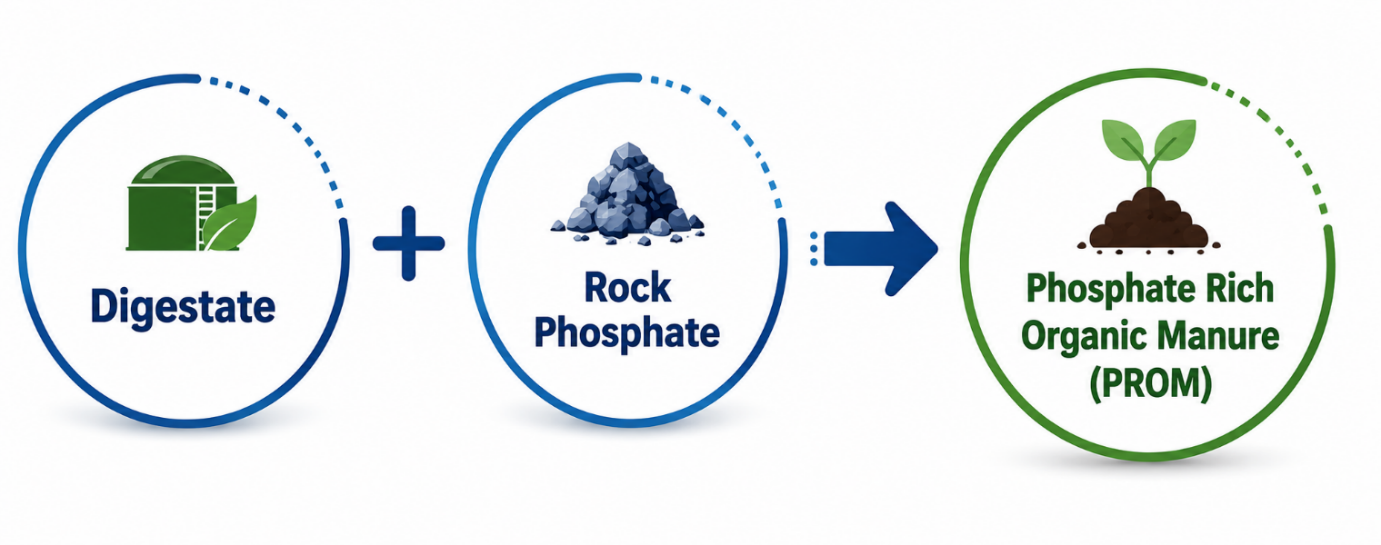
By combining stabilized organic matter with phosphate-bearing minerals, PROM delivers both organic carbon and plant-available phosphorus, supporting improved soil fertility and nutrient-use efficiency. This value-addition pathway significantly enhances the commercial potential of digestate while contributing to sustainable nutrient management practices.
Depending on project configuration and market requirements, a substantial portion of recovered organic manure can be upgraded into PROM, while the remaining material can be marketed as high-quality compost and organic fertilizer through agricultural distribution networks. This integrated approach enables the generation of multiple agricultural products from a single waste stream, maximizing resource recovery and overall project economics.
The growing demand for organic fertilizers, coupled with increasing interest in regenerative agriculture and reduced dependence on imported phosphatic fertilizers, presents a significant market opportunity for both FOM and PROM within the agricultural sector.

Biofertilizers & Nutrient Recovery
Converting Organic Waste into Agricultural Value
Rigel BioEnviron Solutions has developed an integrated biorefinery platform that converts organic waste into multiple high-value outputs, including Bio-CNG, PHA bioplastics, organic fertilizers, and nutrient recovery products. By combining renewable energy generation with resource recovery, the platform maximizes value creation while supporting circular economy and sustainable agriculture objectives.
Beyond energy production, organic waste contains significant quantities of nutrients essential for soil fertility and crop growth. Through anaerobic digestion and downstream nutrient recovery processes, these nutrients can be recovered and transformed into valuable agricultural inputs rather than being lost through disposal or landfilling.
Nutrient Recovery from the Biorefinery
During the biogas production process, nutrient-rich digestate is generated as a natural co-product. Globally, digestate is increasingly recognized as a valuable resource containing organic matter, nitrogen, phosphorus, potassium, and micronutrients that can be utilized in agriculture.
Within the integrated biorefinery ecosystem, digestate and recovered nutrient streams can be further processed into various value-added agricultural products, including:
- Liquid Fermented Organic Manure (LFOM)
- Phosphate Rich Organic Manure (PROM)
- Enriched organic fertilizers
- Soil conditioners and organic amendments
- Nutrient recovery products for sustainable agriculture
This approach ensures maximum utilization of every tonne of feedstock while reducing waste and improving overall project economics.
Phosphate Rich Organic Manure (PROM)
PROM is an enriched organic fertilizer produced by combining stabilized organic matter with phosphate-bearing minerals. It provides phosphorus together with organic carbon and biological nutrients that help improve soil fertility and nutrient availability.
As agricultural systems increasingly focus on soil regeneration and reduced dependence on chemical fertilizers, PROM is gaining importance as a sustainable nutrient source that supports long-term soil health while contributing to improved crop productivity.
Liquid Fermented Organic Manure (LFOM)
LFOM is a liquid organic nutrient product derived from nutrient-rich digestate streams. It contains readily available nutrients, organic compounds, and beneficial biological components that support plant growth and soil microbial activity.
LFOM can be applied across a wide range of agricultural systems and is increasingly being adopted as part of integrated nutrient management and regenerative farming practices.
Growing Market for Organic Fertilizers
Global demand for organic fertilizers and nutrient recovery products is increasing due to rising concerns regarding soil degradation, excessive chemical fertilizer usage, declining organic carbon levels, and the need for sustainable agricultural inputs. Governments, agricultural institutions, and food producers are increasingly encouraging the adoption of biological and organic nutrient solutions that improve long-term soil health while reducing environmental impacts.
In India, the growing emphasis on sustainable agriculture, nutrient recovery, and circular bioeconomy solutions is creating significant opportunities for products such as LFOM, PROM, enriched organic manure, and digestate-derived fertilizers. The increasing participation of fertilizer companies and agricultural distribution networks is further supporting market expansion for these products.

Integrated Circular Value Creation
A key advantage of Rigel’s biorefinery platform is its ability to generate multiple value streams from a single waste source:
- Bio-CNG for renewable energy.
- PHA bioplastics for sustainable materials.
- LFOM, PROM, and organic fertilizers for agriculture.
- Resource recovery products supporting circular economy goals.
By integrating energy production, sustainable materials manufacturing, and nutrient recovery within a single platform, the biorefinery transforms organic waste into valuable resources while supporting climate action, soil restoration, and sustainable development.
Closing the Resource Loop
The future of waste management lies in complete resource recovery. Through the combined production of renewable energy, sustainable bioplastics, and nutrient-rich agricultural products, the integrated biorefinery creates a circular system where waste becomes a resource for energy, materials, and food production.